
Fake Stake Mines: How to Play the Free Mines Game
6 min
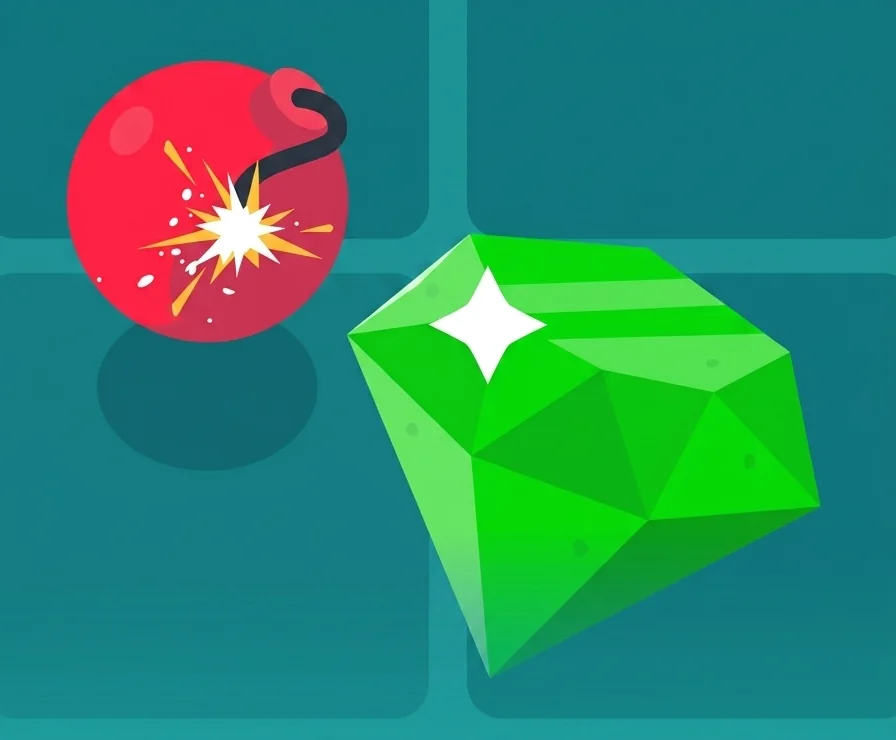
What is Fake Stake Mines?
Fake Stake Mines is the free-money version of the grid game everyone knows from crypto casinos. You are shown a 5x5 board hiding a number of bombs, and your job is to reveal safe tiles, raising your multiplier with each one, and cash out before you hit a bomb. On FakeStake the entire thing runs on virtual coins, so you can play it as much as you like with nothing at stake.
It is one of the simplest casino originals to learn and one of the most satisfying, because every single pick is a small decision: bank what you have, or push for one more tile and a bigger payout.
How Fake Stake Mines works
Before each round you choose how many bombs to hide, anywhere from one to twenty-four. Fewer bombs means safer picks but tiny multiplier growth; more bombs means every tap is a gamble for a much larger payout. Each safe tile you reveal multiplies your stake by a factor tied to the shrinking odds of survival. You can cash out after any pick — that flexibility is the whole game.
The odds behind the grid
The number of mines sets everything. With three bombs on a 25-tile grid, your first pick is safe about 88% of the time, but the odds compound against you with each additional tile you reveal. By the time you have uncovered several tiles, the chance of the next one being safe has dropped noticeably. Understanding that curve — safe early, riskier the deeper you go — is the core skill in Mines, and playing with fake money is the risk-free way to feel it.
The smartest way to play
Because Mines rewards restraint, the disciplined approach is to decide a target number of safe picks in advance — say four or five — and cash out there rather than chasing. Raising the bomb count for a bigger multiplier also sharply increases variance, so match it to how much of your (fake) balance you are willing to swing. There is no pattern to exploit: each grid is independent, generated fresh, so no tile is ever 'due' to be safe.
Common mistakes to avoid
The classic error is greed — revealing one tile too many after a good run and losing everything. The second is jumping to a high bomb count chasing a jackpot multiplier without accepting how rarely it lands. Fake money is the perfect place to feel both mistakes without paying for them.
Why learn Mines with fake money
Mines is the ideal game to practise for free precisely because it is about discipline, not luck you can influence. Play Fake Stake Mines to build the habit of cashing out at a planned point and to see how quickly the bomb risk compounds, all without losing a cent. Remember that fake-money results never predict real-money outcomes, and if you ever play for real, only stake what you can afford to lose. 18+.
Choosing your bomb count in Fake Stake Mines
Your first decision each round is how many bombs to hide, and it shapes everything. A low count — one to three bombs — means most tiles are safe, so you can reveal several for a steady, low-variance climb, but each safe tile adds only a small multiplier. A high count — ten or more — turns every single pick into a gamble, with huge multipliers if you survive but frequent instant losses. There is no 'correct' number; it is purely a trade-off between how often you win and how big those wins are. Fake money lets you test the whole range for free.
The maths of cashing out
The core skill in Mines is knowing when to stop, and it comes down to expected value. Each additional tile multiplies your potential payout but lowers your chance of getting there. Early picks are cheap insurance — high survival odds for a modest bump — while later picks are increasingly a gamble. A disciplined player decides a target number of tiles before the round and banks there, rather than letting a hot streak talk them into 'just one more'. Practising that call with fake money makes it automatic.
Low-risk vs high-risk Mines strategies
Two broad approaches work depending on your temperament. A low-risk style uses few bombs and cashes out after two or three safe tiles, grinding small, frequent wins — steady but slow. A high-risk style uses more bombs and chases a big multiplier from a handful of picks, accepting that most rounds will bust. Neither beats the built-in house edge over time; they simply shape the variance. Fake Stake Mines is the perfect place to try both and see which suits how you like to play.
Why there is no pattern to exploit
It is tempting to look for patterns — a lucky tile, a 'due' safe corner — but each Mines grid is generated independently, so previous rounds tell you nothing about the next. The bomb positions are random every time. That means no tapping order is safer than another, and no streak is a signal. Accepting this is liberating: it lets you focus on the one thing you actually control, which is your cash-out discipline, rather than chasing superstitions.
Practising Mines the smart way
To get the most from free Fake Stake Mines, play with intent. Pick a strategy — say three bombs, cash out after four tiles — and run it many times to see how it performs over a real sample, not just one lucky or unlucky round. Then try a higher-risk setup and compare. You will quickly develop an honest feel for how the risk-reward curve behaves, which is exactly the understanding that stops costly mistakes if you ever play a real version.
The bottom line on Fake Stake Mines
Fake Stake Mines is a simple, tense, decision-driven game that rewards discipline over luck-chasing, and it is the ideal original to learn for free. Choose your bomb count, plan your cash-out, and practise banking at a set point rather than pushing your luck. Play it as entertainment, remember that fake-money results never predict real outcomes, and if you ever play for real, only stake what you can afford to lose. 18+.
A worked example of a Mines round
Picture a round with three bombs. You reveal your first tile — safe, with an 88% chance it would be. Your multiplier ticks up a little. You reveal a second, then a third; each is safer than average but the multiplier is still modest. Now you face the real decision: cash out a small, near-certain profit, or reveal a fourth tile where the odds have tightened noticeably. A disciplined player who planned to stop at four banks it here. A greedy one reveals a fifth, then a sixth, and eventually meets a bomb. That single decision — where to stop — is the whole game.
How mine count changes the feel
Try the same idea at different bomb counts and the game transforms. With one or two mines it feels gentle and grindy; you can reveal many tiles safely for small, steady gains. With ten or more it feels sharp and brutal — one or two picks for a big multiplier, or an instant loss. Neither is 'better'; they are different experiences of risk. Playing the range for free is how you discover which one you actually enjoy sitting through.
Bankroll and bet sizing in Mines
Even with fake money, practise sizing your bets sensibly relative to your balance rather than going all-in every round. High-variance Mines setups can string together several losses, so a bet that is a small fraction of your balance lets you ride out the swings and keep playing. This is exactly the bankroll discipline that protects real players, and rehearsing it in free Mines makes it automatic if you ever play a paid version.
The mindset that wins at Mines
If there is one takeaway, it is that Mines rewards a calm plan over a hot hand. Decide your bomb count and your cash-out target before the round, execute it, and repeat — treating each round as independent, because it is. The players who struggle are the ones who let a good run tempt them into greed or a bad run into chasing. Fake money is the perfect place to train that steadiness at zero cost.
Quick answers to common Mines questions
New players tend to ask the same handful of things about Mines, so here are quick answers. Is there a best number of mines? No — fewer mines means safer, smaller wins and more mines means riskier, bigger ones; it is a preference, not a solution. Can you predict where the bombs are? No, each grid is random and independent. Is there a guaranteed winning strategy? No — the house edge applies, and the only real skill is disciplined cash-out timing. Should you always cash out early? Not necessarily, but a planned target beats greed every time. Does a losing streak mean the game is 'due' to pay? No, past rounds never influence the next. Getting these straight saves a lot of confusion, and the beauty of Fake Stake Mines is that you can test every one of these answers yourself, for free, until they make intuitive sense.
Frequently asked questions
How do you play Fake Stake Mines?
Choose how many bombs to hide on the 5x5 grid, reveal safe tiles to raise your multiplier, and cash out before you hit a bomb. On FakeStake it is all fake money.
What are the odds in Mines?
They depend on the bomb count. With three mines, your first safe pick is about 88% likely; each further pick lowers your survival odds while raising the multiplier.
Is Fake Stake Mines free?
Yes — it runs on fake, no-value currency with no deposit and no account required.
What is the best Mines strategy?
Pick a target number of safe tiles in advance and cash out there. Lower bomb counts are steadier; higher counts are high-variance.
Read next
Demo only - all games use virtual currency. No real money, no withdrawals, no prizes. Gambling with real money can be addictive; if you need support visit ncpgambling.org or call 1-800-GAMBLER. 18+ only.