
Fake Casino Streamers: Is the Money Real?
7 min
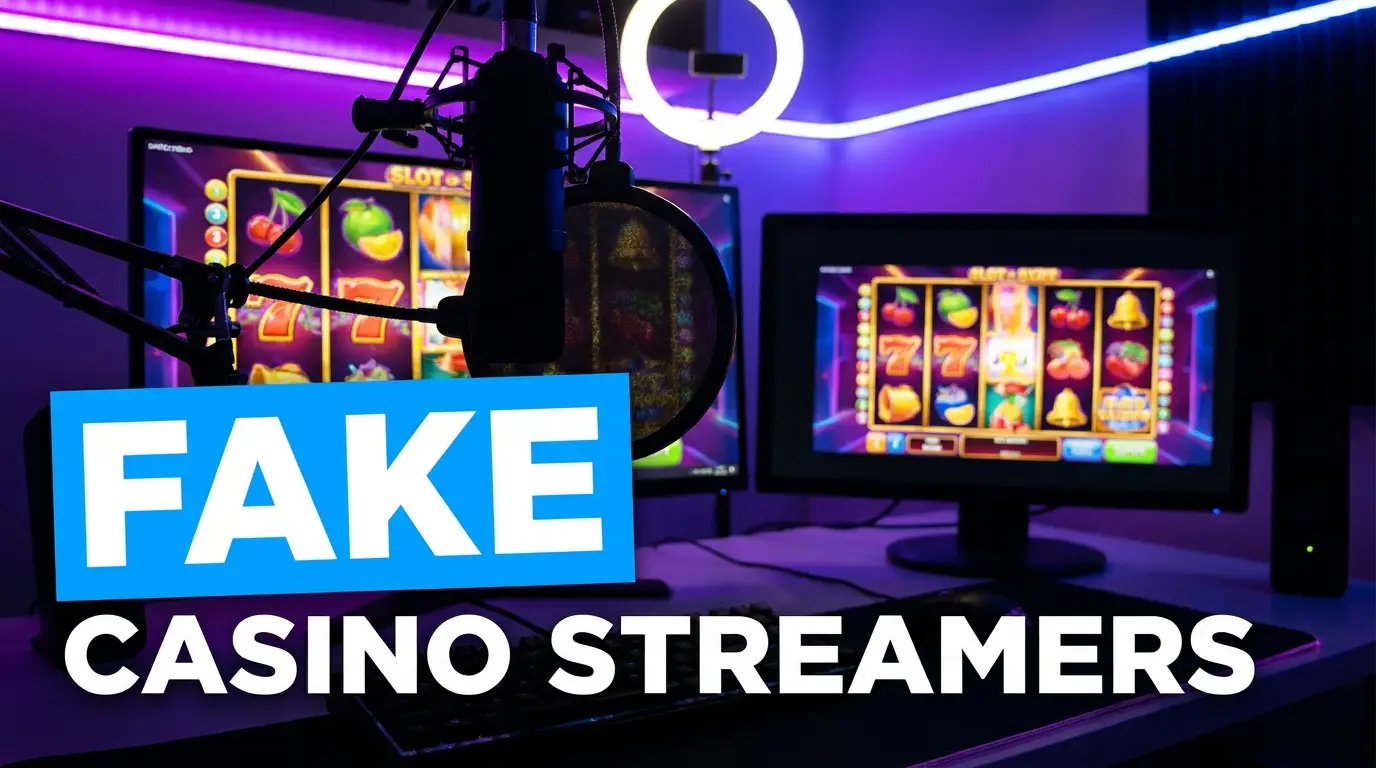
Why people search for fake casino streamers
Gambling streams show people staking more on a single spin than most viewers spend in a month. The obvious question follows, and it is why so many people search for fake casino streamers: is that their own money, or is the whole thing staged?
The honest answer is that it depends on the streamer, and viewers usually cannot tell. This article sets out what is publicly known in general terms, why a stream can mislead even when every bet is real, and how to watch with a critical eye.
We do not name streamers or casinos here, and we make no claims about any individual. The points below apply to the format as a whole.
Do casino streamers use fake money? What is publicly known
Some things are not in dispute.
- Sponsorship deals exist. Many large gambling streamers have a commercial relationship with a casino. The logo is on the stream and the link is in the description.
- Terms are rarely disclosed. Viewers generally do not see the contract, the fee or the conditions attached.
- Some streamers have said publicly that they are paid to play. Others say they use only their own money.
- Disclosure rules exist. Platforms and regulators require sponsored content to be labelled, and enforcement is uneven.
Arrangements reported in the industry include flat fees, a share of revenue from referred players, and balances supplied by the operator for use on stream. Which of these applies to a given stream, if any, is something a viewer has no means of checking.
That uncertainty is the real answer. Both claims, "it is all fake" and "it is all their own money", go further than the evidence available to someone watching.
What "fake" can mean on a gambling stream
People use the word fake for several different things. It helps to separate them.
| What viewers mean | What it involves | Can a viewer verify it? |
|---|---|---|
| Supplied balance | The operator funds the play in some way | Not without disclosure of the deal |
| Paid to play | The streamer earns a fee whatever the result | Only if the streamer says so |
| Demo or play-money mode | The game runs on a balance with no cash value | Sometimes, if the interface shows it |
| Edited highlights | Real play, cut down to the best moments | Yes, by comparing clips with full streams |
| Doctored images | Screenshots or clips altered after the fact | Rarely |
The last row matters more than people think. Browser tools exist that change the balance shown on a page, and a screenshot of a huge win is easy to produce. A still image posted on social media is weak evidence of anything.
None of this means a particular stream is staged. It means the format gives viewers very little to go on.
Are gambling streams fake if the games are real?
Suppose every spin is genuine and the game runs exactly as it does for anyone else. The stream is still not a fair picture of gambling. There are three reasons.
The risk is not the same
Someone paid to play, or playing with a balance supplied for the purpose, does not carry a loss the way a customer does. Even a streamer using personal funds may earn more from the stream than is lost on it. A viewer has none of that cushion. For the viewer, every lost bet is simply gone.
Volume hides the cost
Hours of high-stake play produce big wins as a matter of course. They also produce larger losses, which make worse clips. Expected loss is the total amount wagered multiplied by the house edge, so more volume means a larger expected loss, not a better chance of coming out ahead.
Highlights are selected
The huge multiplier is cut into a short video and shared widely. The many sessions without one are not. What reaches most people is a set of the best minutes from a very large number of hours.
What the maths says about big wins
Rare outcomes are rare for one player and routine across enough play. Plinko shows this well. On a 16-row board, each edge slot is a 1 in 65,536 chance per ball. A viewer dropping a few hundred balls should not expect to see one. Someone dropping tens of thousands of balls on camera will see it eventually, and that is the clip that gets shared.
The same applies to Crash and Limbo. The chance of reaching a multiplier is roughly 0.99 divided by that multiplier, so 10x comes in about 9.9% of the time and 2x about 49.5%. A very high multiplier is a matter of waiting through enough rounds, and each of those rounds costs a bet.
The house edge applies to everyone. It is typically about 1% on originals such as Dice, Limbo, Crash, Mines and Plinko, 2.70% on European roulette and commonly 3% to 6% on slots, with figures varying by site. Rounds are independent, and no staking pattern changes the edge. A streamer's big win is the same maths you would face, viewed through a much larger sample. Our house edge guide explains the calculation.
Rules on disclosure
Streaming platforms and advertising regulators in many countries require sponsored content to be labelled. Some platforms have also restricted streams of certain gambling sites. The rules differ by platform and by country, and enforcement is uneven.
A label has limits even when it is used correctly. It tells you that a commercial deal exists. It does not tell you how much was paid, whether the balance was supplied, or what the streamer's results look like across a whole month.
The absence of a label does not prove independence either. It may mean no deal exists, or it may mean the rule was not followed.
How to watch gambling streams critically
You do not need to stop watching. You need to know what you are watching.
- Treat it as advertising and entertainment. It is not evidence of what you would win.
- Look for full sessions, not clips. A long unedited stream shows the losing stretches that highlights remove.
- Watch the bet size. A win that looks enormous may be a modest multiplier on a very large stake.
- Ask who carries the loss. If the answer is unclear, assume the streamer's position is not comparable to yours.
- Be wary of urgency. Codes and links pushed with time limits are sales tools. The streamer is typically paid when viewers sign up or play.
- Ignore systems. A staking pattern that appears to work on stream is a short sample. Over time the edge is unchanged.
- Distrust screenshots. A still image of a balance or a win proves very little.
Common mistakes viewers make
- Scaling the stream down. Betting a hundredth of the stake does not give you a hundredth of the experience. With far fewer rounds, you are unlikely to see the rare hits at all.
- Copying the game choice. High-volatility games make the best content because the swings are dramatic. Those same swings empty a small balance quickly.
- Reading confidence as knowledge. A streamer who sounds certain about the next round has no information that you lack. The outcome is random.
- Thinking a bonus code changes the odds. It changes the terms of a promotion, and those terms usually come with conditions.
How to try the same games for free
If the appeal is the games themselves, you can play the same formats without any money. Fake Stake Mines, Plinko and Crash run on virtual coins, and the slot demos use play money.
You start with 10,000 coins. There is no deposit, no account and no cash-out, and the balance can be reset. Fake Stake is independent and is not affiliated with Stake or any casino.
A useful test is to recreate what you saw on a stream. Pick the same game and a similar target, play a few hundred rounds and count how often the big multiplier arrives. A good run with fake coins predicts nothing about real play, but the hit rates you observe are a far better guide than a highlight reel. Our Stake simulator guide has an experiment for each game.
A note on age and risk
Many gambling stream viewers are young. Real-money gambling is for adults aged 18 and over, and it is restricted or illegal in many places. If you are under 18, gambling sites are not for you, whatever a stream suggests.
If gambling is causing problems for you or someone you know, the National Council on Problem Gambling (ncpgambling.org) offers support, and in the US you can call 1-800-GAMBLER.
The takeaway
Some streamers gamble their own money and some are paid to play, and a viewer can rarely know which. What is certain is that a sponsored, high-volume, edited stream does not show what gambling is like for an ordinary player. Enjoy the content for what it is, and use fake money if you want to try the games. 18+ only.
Frequently asked questions
Do casino streamers use fake money?
It varies. Some say they play with their own money, and some have said publicly that they are paid to play. Unless a streamer discloses the terms of a deal, viewers cannot know.
Are gambling streams fake?
The games generally run as normal, so the spins themselves are usually not staged. What is misleading is the picture: a sponsored streamer wagering large sums for hours is not what an ordinary player should expect.
Why do casino streamers bet such large amounts?
Big stakes make better content, and a sponsored streamer may not bear the losses in the way a normal customer would.
Do streamers have to say when a gambling stream is sponsored?
Streaming platforms and advertising regulators in many countries require sponsored content to be labelled, but enforcement is uneven. A label tells you a deal exists, not whose money is being wagered.
How can I try the same games without risk?
Use a fake-money simulator such as Fake Stake, where Mines, Plinko, Crash and slot demos run on virtual coins with no deposit and no account.
Read next
Demo only - all games use virtual currency. No real money, no withdrawals, no prizes. Gambling with real money can be addictive; if you need support visit ncpgambling.org or call 1-800-GAMBLER. 18+ only.